“How do you kill community? I can tell you one thing sure to do the job: Be self-sufficient.”
These words from a poem by Tad Hargrave struck me. We often think of community as a group of people coming together to share their wins. But Hargrave suggests something far more radical: the glue of a true community isn’t shared success; it’s shared vulnerability.
How do you create community?
I don’t know.
A hundred ways.
A thousand ways.
But, how do you kill community?
I can tell you one thing sure to do the job.
Be self-sufficient.
Always have enough.
Always have it together.
Always be a giver.
Always have all the tools you need.
Never need to borrow a sewing needle.
Never need a cup of sugar.
Never tell anyone you’re breaking down.
Never need anyone.
Your pride, your insistence on competency, your unwillingness to be a burden, on us when it is the proper time for you to collapse may be the end of us all.
Knowing what time it truly is, or knowing how to know the time at all, you, needing our help, being unable to continue without it, you, not knowing how to do everything, creates the occasion for the village to reconstitute itself and know itself again.
–Tad Hargrave
When we insist on “having it together” or refuse to be a “burden,” we actually deny others the opportunity to be generous. In doing so, we starve the community of its primary function. As Hargrave puts it:
“Your pride, your insistence on competency…may be the end of us all. Knowing what time it truly is—you, needing our help—creates the occasion for the village to reconstitute itself and know itself again.”
Moving From “Self-Sufficient” to “Interdependent”
Modern society is often over-managed and under-connected. We are taught to be independent islands, yet we wonder why we feel so isolated.
Yoga offers a direct remedy. While many view yoga as a solo physical endeavor, its roots are deeply communal. It is a practice of union—not just within ourselves, but with the collective. In the yogic tradition, we move from the ego of the “self” to the wisdom of the sangha.
Three Ways Yoga Teaches Us to Connect
Here is how we can apply ancient yogic principles to the modern challenge of building community:
- Aparigraha (Non-attachment): Letting Go of “The Expert”
- Aparigraha is often translated as non-greed, but it also applies to our ego. To build community, we must let go of our attachment to being “competent” or “perfect.” In a yoga space, our pride is often the biggest barrier to our growth.
- The Sangha: A Living Organism
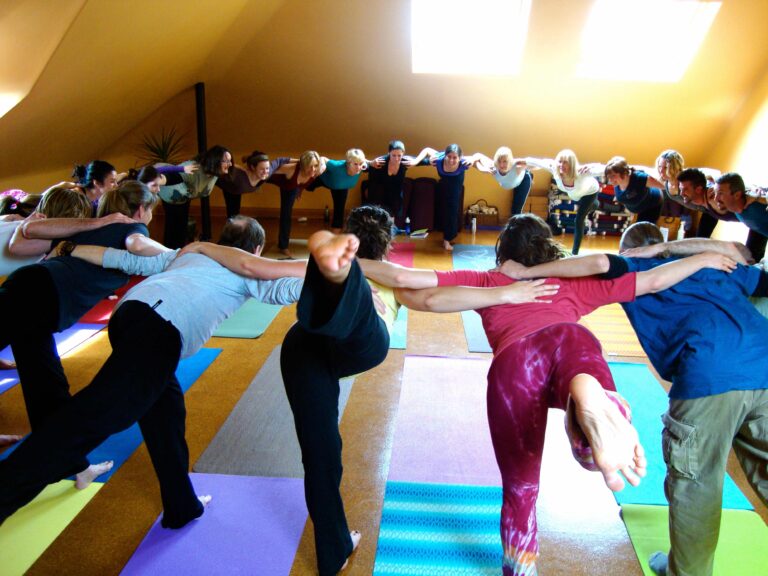
- A Sangha (community) is not just a group of people in the same room; it’s a living organism that thrives on the exchange of support. Practicing together isn’t just about synchronized movement—it’s about shared prana (energy). When one person struggles, it creates a sacred opening for others to practice karuna (compassion). Your “collapse” is the very thing that allows the group to hold space for you.
- Vulnerability as Asana: Finding Stability in the Unstable
- In our physical practice, we often find ourselves in poses where we are physically unstable. This is a metaphor for life. Accepting that instability and the uncertainty of life is a form of svadhyaya (self-study). When we stop wearing the mask of perfection on the mat, we give everyone else in the room permission to do the same.
The Structure of Belonging
| Aspect | The Isolated Individual | The Sangha Member |
| Relationship to Struggle | Something to hide/fix alone. | An “occasion” for the village to meet. |
| View of Others | Potential judges or competitors. | Part of one’s own extended body. |
| Energy Source | Internal battery (easily drained). | Collective current (prana). |
| Purpose | Personal achievement. | Collective liberation and peace. |
The greatest gift you can give your yoga community isn’t your perfect handstand or your perceived flawless life—it’s your vulnerability. By being “a burden” when the time is right, you are actually performing an act of service, allowing the sangha to fulfill its purpose.
The Invitation
Community isn’t built through mandates; it’s built through invitation and accountability. Today, I invite you to “know what time it truly is.” If you are struggling, let yourself be seen. If you are strong, be ready to catch.
While we spend a lot of time on our individual mats/personal practice (sadhana), it is the sangha (community) that gives yoga practice its deepest meaning.
Thank you to Peter Block for your inspiration! Learn more about our Yoga for the Common Good work!
“What we need is each other. And when we act together, we will create competence in our community and satisfaction in our lives.” -Peter Block
Get Inspired!
Our Collective Heart
Yoga for the Common Good
World Peace Yoga FREEdom Month
Posted by Anna Ferguson, author of World Peace Yoga: Yoga for People Who Breathe, a book on yoga that inspires peace in action, developing intuition, deepening empathy, and expanding compassion. Connect with Anna on Insight Timer for FREE meditations, at World Peace Yoga in Cincinnati and via Instagram @annafergusonpeace or via Facebook or join her for a class at www.worldpeaceyoga.com.