
Have you ever felt like you do not fit in, that you’re awkward or out of place? If so, you’re not alone. I’ve felt this way from a young age. From the time my parents divorced around age five and into my adulthood I held this belief that I do not belong. Whether it was with my family, at school, a friend group, or the culture as a whole, I simply felt like I did not fit in.
In an interview I was listening to with Brené Brown, she said, “the opposite of belonging is fitting in” and this statement really struck me.
Fitting in means changing yourself, assessing, or acclimating to be accepted by a person or group, while true belonging means showing up as your authentic self and being accepted for who you are, even risking disconnection.
Fitting in is about changing to meet expectations of others, which betrays yourself, whereas belonging requires the courage to be yourself and stand in your values, even if it means standing alone.
What a powerful statement – the OPPOSITE of belonging is fitting in.
It has been part of my meditation practice to make a conscious effort to let go of the belief that I do not belong and affirm that I do belong (mantras and affirmations I like for this toward the end of this post). Feeling a sense of belonging, acceptance, and love is why I appreciate and share the practice of yoga. It is also one of the reasons why World Peace Yoga exists. There is something powerful about coming together in community to simply breathe and be. Just be. Just be YOU, your authentic self.
Maya Angelou viewed belonging not as finding a specific place, but as an internal state of being, famously stating, “You are only free when you realize you belong no place-you belong every place-no place at all.” True freedom comes from realizing your worth is inherent, allowing you to belong to yourself first, which then enables genuine connection and self-acceptance in any environment, rather than changing yourself to fit in.
This inner sense of belonging is achieved through self-love, self-awareness, and honoring your authentic self, making you resilient and empowered, even in ambiguity or uncertainty.
Fitting In
- Action: Assessing a group and changing your behavior, speech, or appearance to match their expectations.
- Motivation: To gain acceptance and avoid rejection.
- Outcome: Hollow, unsustainable, and a betrayal of self.
Belonging
- Action: Being your authentic self and having the courage to stand alone if necessary.
- Motivation: Authenticity and connection to self and others.
- Outcome: Brave, sustainable, and fosters true connection and creativity.
Takeaways on this view on belonging:
- Belong to Yourself First: The most crucial form of belonging is cultivating a deep, loving relationship with yourself, realizing you are enough as you are.
- Freedom in Detachment: By understanding you don’t need a single place to belong, you become free from the pressure to conform and can find belonging everywhere.
- Authenticity Over Approval: Trying too hard to fit in can be a betrayal of self; true belonging involves aligning with your values and being your true self.
- The “Ache for Home”: It is a core desire (need) as humans to have a safe, inner place where dignity isn’t questioned, balancing the “everywhere” with an internal sanctuary.
- Universal Connection: This perspective emphasizes that diversity enriches life, and we can find connection and value in all people and places, not just those we share similarities with.
How to apply this concept:
- Cultivate Self-Love: Spend quiet time daily to build a strong relationship with yourself.
- Practice Self-Acceptance: Embrace your unique journey and inherent worth.
- Set Boundaries: Prioritize relationships that uplift you and don’t tolerate environments that diminish you.
- Find Purpose: Connect to something larger than yourself to foster meaning and belonging.
Mantras and Affirmations:
Mantras for belonging focus on self-acceptance, connection, and inherent worth, such as “I belong,” “I am enough,” or “I am worthy of love and acceptance.” These mantras or affirmations emphasize that true belonging comes from being authentic, not changing to fit in, and recognizing our shared humanity and connection to the universe.
The Sanskrit mantra So Hum (I am that) affirms your connection to pure awareness/universal consciousness. Lokah Samastah Sukhino Bhavantu (May all beings everywhere be happy and free) fosters universal belonging.
What resonates with you?
- I exist, I matter, I belong.
- I am enough, exactly as I am.
- I am worthy of love and belonging.
- I belong in the spaces I enter.
- I am aligned with my inner light and my light is truth.
- I am centered and at peace.
- I am safe, I am loved, I am supported.
- I am home.
- I am.
- OM.
We all belong. We are all connected.
“Belonging doesn’t require me to change who I am. It requires me to BE who I am.” -Brené Brown
Affirmation playlist and I Am Enough playlist on Spotify to inspire your practice.
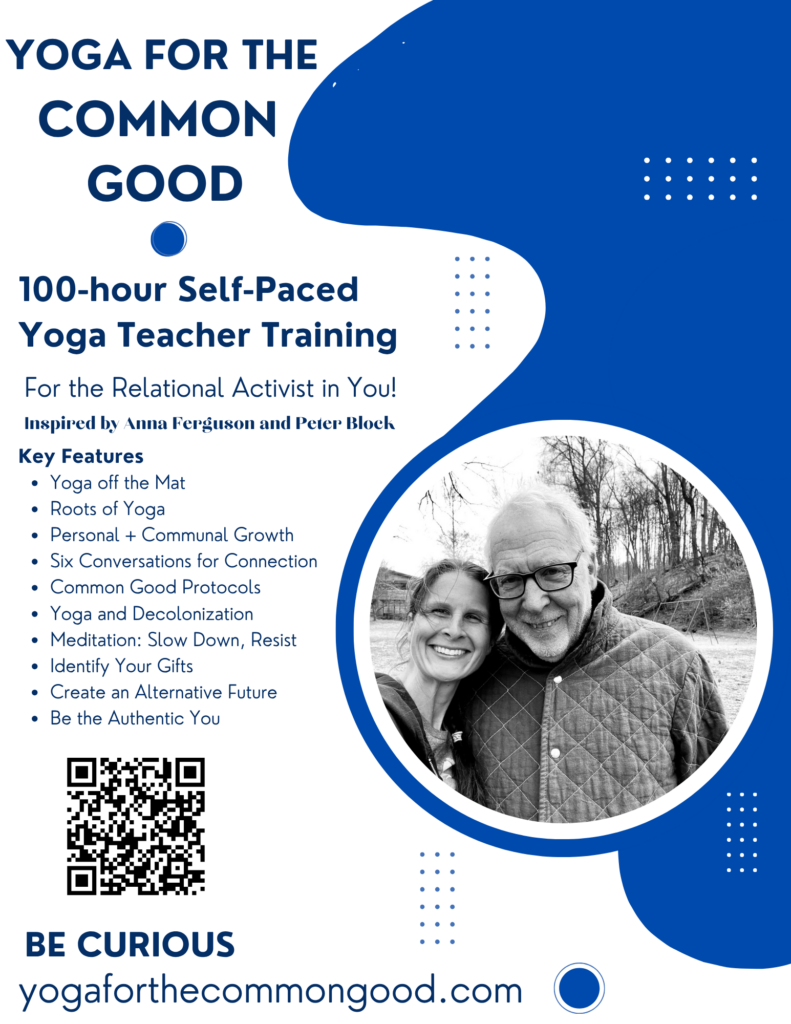
If you’re interested in exploring more on the connections between yoga practice, belonging, and the common good, check out the Yoga for the Common Good course to deepen your experience of yoga, relationships, and life. There is a special introduction workshop on Saturday, February 14, 2026.
Posted by Anna Ferguson, author of World Peace Yoga: Yoga for People Who Breathe, a book on yoga that inspires peace in action, developing intuition, deepening empathy, and expanding compassion. Connect with Anna on Insight Timer for FREE meditations, at World Peace Yoga in Cincinnati and via Instagram @annafergusonpeace or via Facebook or join her for a class online at worldpeaceyogaonline.com.

“We are a community of possibilities, not a community of problems. Community exists for the sake of belonging and takes its identity from the gifts, generosity, and accountability of its citizens. It is not defined by its fears, its isolation, or its penchant for retribution. We currently have all the capacity, expertise, programs, leaders, regulations, and wealth required to end unnecessary suffering and create an alternative future.” -Peter Block, Community: The Structure of Belonging